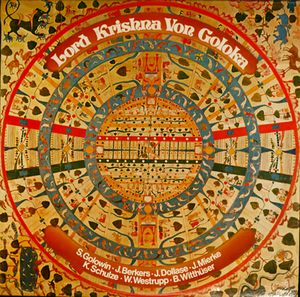
Though Golowin would be lauded primarily for his writing in the area of folklore and esotericism, Golowin turned out a real psych-infused treat with1973’s Lord Krishna Von Goloka. With help from Klaus Schulze (of Tangerine Dream fame),Golowin’s only record certainly captures the blend inviting psychedelia and electronic experimentation, perhaps best on this track. I first heard this release on Soul Jazz Records’ fantastic Deutsche Elektronische Musik 2 compilation. What stands out on this track and others on the album is the blending of acoustic jamming worthy of any flower child with enchanting vocal experimentation. In many ways it reminds me of something like Popol Vuh’s Song of the Earth. Though most versions feature the cover above, check out the cover of the Italian quadrophonic release.
KéPA hails from Bayonne, France though you’d perhaps be forgiven for thinking he hails from somewhere near the Mississippi Delta. Lies Lies Lies is taken from his most recent Low-Low Wind release and he’s got more solo blues stuff over at Bandcamp. According to his website he draws inspiration from the likes of Abner Jay which I can definitely hear in Lies Lies Lies along with the falsetto of John Jacob Niles. You can find out more about seeing him perform on his website or on Facebook. I’d elaborate more on Abner Jay and John Jacob Niles, but I’m planning more elaborate posts on them in the future so just enjoy the tunes ya dingus!
Australian-born composer Madeline Cocoloas’ debut record Cascadia is set to be released in January from Future Sequence, and it’s gorgeous. Much of the material arose from a project she undertook where she created a song a week for a year. It was fittingly called the “Fifty Two Weeks” project, and lucky for us that material has been repurposed, repackaged, and refined for our listening pleasure. I Can See You Whisper was actually the final installment of the 52 weeks project, which she celebrated by releasing a video for the song. Blending her classical training on piano and (I’m guessing) violin/cello with subdued synth drones, she has composed original soundtracks to Hitchcock’s The Birds as well as for site-specific art installations. For more information and to hear past installments in the Fifty-Two Weeks saga, check out the blog she set up for the project or check out her website. You can also hear more of her music over at Soundcloud. I’ll have to remember this project when I get a bit lazy with the Music For Cougars stuff, because it’s not as good and it seems to take twice as long.
Most of these posts are meant to pretty relevant regardless of when some future person might stumble upon them, but this one has got a tinge of urgency because Gap Dream (aka Gabe Fulvimar) is selling downloads of his entire discography for just four dollars! Four. Measly. Dollars. This includes the release which contains today’s track, Florian, which was released under the moniker WARM. What a steal! For the price of something that costs four dollars, you can get all this excellent musics!
I first heard Gap Dream’s self-titled release a couple years ago and purchased the cassette, which I have essentially worn through. I wasn’t aware that he’d been releasing instrumental material under various names, and pretty much all the releases I’ve heard are excellent. For a full accounting of his releases, check out his Bandcamp. While the WARM material is available only digitally, physical releases are handled by the estimable Burger Records out of Fullerton, CA. Before his solo work got started in earnest, he performed with the Black Keys, appearing on their 2002 The Big Come Up release. While he writes and performs all the instruments himself for the WARM releases as well as on the first Gap Dream release, he was joined by Bobby Harlow of Conspiracy of Owls fame for Gap Dream’s sophomore effort Shine Your Light. I’d encourage you to take advantage of this amazing deal while it lasts, but if you’re one of those future people for whom this deal no longer applies, still buy it using whatever currency the future space government will accept. Bitcoin? Straight barter? Idk, just do it.
This track comes off the debut record Odyssey from electronic artist HOME (aka Randy Goff). It was released in 2014 by Midwest Collective, and it’s only a dollar so I strongly suggest snatching it up because from start to finish it’s a treat. He released a second record Before the Night (also on Midwest Collective) that is in the same electro future funk vein as Odyssey so if you dig this I’d recommend checking this out. In addition to Bandcamp, he’s got a presence on Soundcloud where there is some material that is not present on either full-length releases.
This was a tough one to pick just one track from. It comes from nouns’ sophomore record still and let me tell you it’s a treat on repeat. The group formed in high school in Conway, Arkansas. Much of still is informed by the band members’ experience with mental illness, according to an interview with the band’s lead songwriter Hunter Clifton Mann conducted by Mark Garza, who runs the label/site Funeral Sounds:
Q: Mark was telling me there were stories behind Still and I’m not sure if that means musically or lyrically or? I notice for example with all the lyrics are attributed to a different person. I was curious about that.
That is an interesting question. I wasn’t sure how people would take that. I pitched this a month or two before the record came out. Once all the songs had been really fleshed out we kind of noticed, like I wrote all the lyrics and they’re all honest, we were adamant about making something honest but all the lyrics seemed very jumbled. And then, my roommate and I were talking about it. I live with two other people who have severe bipolar disorder and I have bipolar disorder as well and kind of what happened with the record is that the different names attributed to the songs are kind of personas I’ve created in my mind for my most immature state of mind that’s vengeful and angry and completely cynical, then the more mature part of me that some days understands that life isn’t shitty and I’m not cynical about it but at the same time is this complete understanding that I don’t wanna fucking be here. Then there’s the fourth persona on the record who is Oliver and his songs didn’t actually happen, but they were obsessions of mine in high school so Oliver is kind of the most innocent of my personas but also, I don’t know man, I was just obsessed with this one idea in high school that I ended up talking to a lot of people about it over the last year and then it kind of hit me that I should write a fucking song about it and we ended up writing two songs about it just to see if people would relate to it. And, I don’t know. What was the question again?
Mann is joined by Kyle Parker on guitar, Keyton Gill on bass, and Austin Clark on the drums. still was released in 2014 by three different labels, Known Pleasure Records, Funeral Sounds, and Broken World Media on vinyl, with each label producing a different color variant, which is a pretty neat idea. The whole album starts at a buck for a digital download, which is pretty nice, so I’d suggest snapping it up. If your headed down the Ozark way, they update their Facebook with info about shows, which I bet are pretty fun too.
Hailing from the NE (Massachusetts & Rhode Island), 14 Foot 1 is a three-pice rock outfit comprising Casey Belisle on drums with Brad Kreiger and Rob Forsythe on guitar. This track comes off their first record, Christ Grenades, released in 2007 on New Neighbor Records. I couldn’t track down much information on these guys online, though their Facebook does have some upcoming dates and some live videos. They just released a 7″ on New Neighbor Records that you can purchase in physical or digital form on their Bandcamp.
This track comes off the second in a series featuring two virtuosos appropriately titled “East Meets West.” The first in the series was released in 1966 to much acclaim, becoming one of the top selling classical releases of the year and even had a place on the mainstream Billboard charts, perhaps as a result of the interest that American and British bands were showing in Indian classical music at the time. Menuhin had met Shankar in the 1950s, and the two became fast friends, with Menuhin making almost annual trips to India to, among other things, see Shankar. They recounted their meeting and friendship in an interview for the Independent. It makes for pretty interesting reading, as the two excitedly exchanged musical ideas.
SHANKAR: I remember once, in London in the early Fifties, that Yehudi was particularly excited about a composition by Wilhelm Furtwangler, who had written a piece based on an Indian melody in what we call a raga pattern a scientific, precise, subtle and aesthetic melodic form with its own peculiar ascending and descending movement. Yehudi talked to me about the piece, which he was anxious for me to play. I looked at it, and from a Western point of view the composition was very good; but as an Indian sitar player, I felt it was not proper for me to play because it was also, from an Indian point of view, quite childish. It was also written in Western notation which was difficult for me to read, so I asked one of my English students to translate it for me. Eventually, I decided that I would rewrite the piece but that I wouldn’t change the raga. There is a saying in Sanskrit, “Ranjayati iti Ragah” which means: “That which colours the mind is raga.”
The two played their first concert at the Bath Music Festival in 1966 and based on the success of those concerts agreed to record together. While the first two feature primarily Shankar and Menuhin, the third release incorporates other Indian and Western instruments such as the flute (played by Jean-Pierre Rampal) and the tanpura (played by Kamala Chakravarty). The drum on this track is an Indian instrument called a tabla and is played on this recording by Alla Rakha, who often accompanied Shankar and is considered quite accomplished on the instrument. Chakravarty and Rakha also accompanied Shankar at his concert at the Moneterey Pop Festival in 1967. Check out a video of their performance here. The third record features more improvised material and a vocal introduction by Menuhin describing the musical structure to the piece, which is pretty interesting if you’re like me and know nothing about Indian music. If anybody is interested in hearing that I can try to post it, so just leave a comment saying as much and I’ll try to get it up here.
Double Moon comes off the final release from Tyson Torstenson’s art rock project Magical Beautiful entitled Discover Death. Torstensen has been active in the experimental music scene in Chicago since the early 2000s, and he began releasing material under the name Magical Beautiful (along with an array of collaborators) in 2005 with a self-titled release coming in 2006. That first record featured covers/re-workings of songs by artists like Bjork and Joe Meek and had Torstensen performing, mixing, and mastering the release himself. On subsequent Magical Beautiful releases, he would enlist other Chicago artists like Nick Broste, Alance Ward, and Peter Andreadis in various roles. In addition to Magical Beautiful, Torstensen records ambient music with Broste under the name Gaspra and plays bass with the group Axis:Sova. For a full list of his projects, check out his website. The whole record is a really great and it’s free to download on Bandcamp, so if you dig Double Moon I’d encourage you to listen to the rest.
John Adams is an American composer who is often associated with the Minimalist and post-Minimalist movements in American music. While Light Over Water features electronics quite prominently (along with brass instruments), Adams has composed many works which are entirely “acoustic” but which are often influenced by electronic means of composition. According to composer Ingram Marshall, who wrote an essay on Light Over Water over at Earbox:
As synthesizers come to mimic the “real thing,” they truly begin to live up to their hitherto inappropriate name. Technology offers the possibility of a truly synthetic orchestra. Thus Adams, who has a natural gift for composing the lyrical and expressive sounds of instruments, found a technology that could augment and reinforce the orchestral traditions of several centuries.
This is the nascent situation of Light Over Water. Essentially electronic, it was nevertheless born out of the world of the orchestra. In previous works, Adams “electrified” his orchestrations. Now he “orchestrates” his electronics.
This tension between traditional orchestral sounds and electronic means of composition can also be seen in one of Adams’ best known works, Shaker Loops which was released along with Light Over Water by New Albion in 1987. Shaker Loops is written for a string orchestra but it’s repetitive structure of loops played by different string instruments harken back to early experiments with tape loops.
Light Over Water was originally commissioned by the Los Angeles Museum of Contemporary Art in 1983 as accompaniment for an installation choreographed by Lucinda Childs and featuring set design by Frank Gehry. You can watch a tech rehearsal for the performance, which was entitled “Available Light,” here. You can read more about the performance in this article written to commemorate the thirtieth anniversary of the performance.
Other notable works by Adams include Nixon in China, an opera based on Nixon’s 1972 trip to China, Harmonium, and The Death of Klinghoffer. The Death of Klinghoffer has been controversial since its debut, as some have claimed that the opera distorts the story of the Palestine Liberation Front’s highjacking of a cruise ship in 1985, and their murder of Klinghoffer in a way which is antisemitic. After 9/11, the Boston Symphony cancelled a planned performance of excerpts from the opera and former mayor of New York Rudy Giuliani protested the Metropolitan Opera’s production of Klinghoffer.
You can hear samples of each of these works below:

 Orion's Bastard