To commemorate what would have been Pandit Ravi Shankar’s 96th birthday, I thought I’d document another fascinating collaboration of Shankar’s that is in the same vein of East meets West as his collaborations with Yehudi Menuhin, which I have documented in another post. This work arose from a commission Shankar received to compose a work for sitar and an orchestra from the London Symphony Orchestra. Shankar was intrigued by composing in this way following those collaborations with Menuhin, especially since many of those recordings were improvised while this was to be composed in advance. Shankar blurred the lines by including bongo drums instead of the traditional tabla drum typically found in ragas as well as incorporating the call-and-response form that is typical of a concerto into the composition. There are many excellent recordings of Shankar performing more traditional ragas and today would be a good day to dive in, but I wanted to shine a light on this slightly off-beat record in his tremendous body of work. He was a master of the form and his influence on Western perception of Indian classical music and on music in general is difficult to overstate. His legacy lives on in these many recordings and the increased influence of raga forms on contemporary music and in more literal form through his daughter, Norah Jones. This recording, despite being so unorthodox, sold surprisingly well when it was released in 1971, leading one EMI executive to remark that it “sold like a pop record.” Somehow I find it hard to believe that this trend could be repeated, but one can dream.
Category: track of the day
Pas De Deux – Cardiocleptomanie
Those who have followed the annual Eurovision song contest for a long time might remember Pas De Deux from their 1983 entry representing Belgium entitled Rendez-vous. You can watch their performance at the contest here, which the announcer introduces by saying
I’ve described this as sort of crypto-punk. I suppose Belgium deserves some credit for trying something new.
That glowing introduction was delivered with classic British passive-aggressive disdain, but given how fresh Cardiocleptomanie sounds today I think this Belgian group got the last laugh. The group comprised Dett Peyskens (who is currently part of the group Red Zebra), Hilde Van Roy, and Walter Verdin. Cardiocleptomanie comes off the group’s only full-length release Axe Ends which also came out in 1983. The synths probably give this one away as being early-80s, but the combination of driving rhythms and almost disinterested vocals are irresistible. Perfect for anybody who has ever harbored a little crush on the girl from the cover of Duran Duran’s Rio.

Joe Townsend – Going Over The Hill
Though Mississippi Records/Little Axe Records has gone through some re-branding/changes in management, they consistently put out top notch reissues. Their reissues of obscure blues records, either in their entirety or in compilation form, are particularly excellent and Oh Graveyard You Can’t Hold Me Always is a perfect example. I couldn’t find any sort of temporal or geographic limitation that guides this compilation, but it’s made up of bluesy gospel tunes that certainly have the feel of live recordings made in homes and churches throughout the south. I couldn’t find much information on Joe Townsend, but his tune Take Your Burdens to the Lord has appeared on a number of other compilations. Mississippi Records is responsible for a number of great releases that I can personally endorse, including The Life and Times of Abner Jay and Michael Hurley’s Armchair Boogie, but I have yet to come across material they put out that doesn’t have some hidden gems waiting to get the audience they deserve. They have a record store in Portland, OR so if you’re in that neck of the woods I’d encourage you to check it out.
megaritual – Eclipse
megaritual is the brainchild of Australian multi-instrumentalist Dale Paul Walker, and his latest, Eclipse, represents a maturation of forms laid out in two earlier releases, Mantra Music (Vol. 1) and Mantra Music (Vol. 2). While the first two releases were Walker-only joints, he is joined on eclipse by bassist Govinda Das. Blending Indian-style raga forms with heavy guitar rifts is a clever concept, and Eclipse combines the two masterfully into a one-track release which is both meditative and apocalyptic. You can name your price to get it, along with the other two megaritual releases, and if you dig Eclipse then I’d recommend checking the two earlier EPs out as well. I wasn’t able to find anything in the way of physical releases, at least at present, but I’ll edit the post should anything cross my path. For now fire up those ear cans and rock the fuck out.
Jessica Moss – Plastic Island
You may not have heard Jessica Moss’ name before, but you’ve probably heard her violin. She appears on Godspeed You Black Emperor!’s album F♯ A♯ ∞, Arcade Fire’s Funerals, and one of my favorite albums of all time, Broken Social Scene’s debut Feel Good Lost, among others.
Under Plastic Island is her first solo release, though she’s also part of At Silver Mt. Zion and Black Ox Orkestar with other members of Godspeed You Black Emperor!. Despite her connections to so many well-known groups, she clearly has a highly developed aesthetic all her own, blending electronic drones, violins, and beautifully manipulated vocals. For more information about Moss, check out her site. Though Under Plastic Island was released on cassette, it is only available at performances. Her touring schedule will be updated here in the future.
It’s a Beautiful Day – Essence of Now
It’s a Beautiful Day was part of San Franscisco’s burgeoning psychedelic rock scene in the late 60s. Essence of Now comes from the group’s second release Marrying Maiden from 1970. David LaFlamme played a key role in this release, performing as a vocalist, guitarist, and violinist (he was a soloist with the Utah Symphony before the group started). Jerry Garcia provided pedal steel guitar on this release, as he would for seemingly everybody in SF in the 1960s, including CSNY and its component members, Jefferson Airplane, and David Bromberg in addition to his work with the Dead.
Their best known song, White Bird, came from their self-titled debut and while they put out a few more albums they never reached the same level of success. Luckily they left behind these sun-dripped jams.
M. Mucci – Dangerous Summer
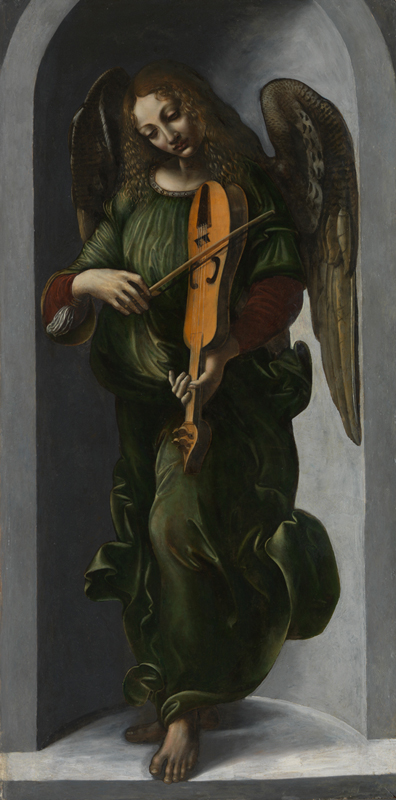
This is the title track from M. Mucci’s 2013 release put out on vinyl by Tall House Recording Co.. The distinctly medieval sounds accompanying M. Mucci’s guitar come from a Vielle, here performed by B. Grossman. The vielle is a stringed instrument somewhat resembling a violin but with five strings instead of four, and it was a popular instrument among troubadours and court musicians during the medieval period. In the 15th century the word began to be used when referring to a hurdy-gurdy which is also a stringed instrument but which is performed by a mechanical wheel turning against the strings instead of a human bowing them, in the case of the vielle.
M.Mucci has a Bandcamp page with lots more music, though I’m not sure if more medieval instruments make appearances.
Below is an image from the National Gallery in London depicting an angel playing the stringed instrument, likely painted by a contemporary of Da Vinci.
Snoozer Quinn -Lover Come Back to Me/ On the Alamo
I found this track on a great post over on Dusted Magazine’s blog where American Primitive guitarist Glenn Jones laid out some of his favorite guitar pieces that don’t fit into the American Primitive mold. Despite being well respected by guitarists both of his day and since, little is known about Snoozer Quinn and very little of his playing was ever recorded. He was born Eddie Quinn in Pike County, Mississippi in 1907 and spent his young adult life touring Texas and the South as a guitarist in a number of travelling bands. He joined the popular dance band the Paul Whiteman Orchestra in 1928 and recorded with other well-known artists like Bix Beiderbecke and Jimmie Davis throughout his career, though some of those recordings have been lost. In case the sounds of Love Come Back to Me/On the Alamo weren’t mournful enough for you, this recording was made in a New Orleans charity hospital where he eventually died of tuberculosis. They are some of the only recordings that capture his playing by itself.
He was credited as a songwriter on the excellent Jimmie Davis song There’s Evil in Ye Children and perfomed on a number of other Davis recordings which survive today like Market Blues and Midnight Blues. I’d encourage you to look at Quinn’s Discogs to see where he performed, since only one compilation is dedicated to Quinn by himself. I suppose Quinn’s story serves as a reminder that if you are good at something, keep doing it because you might be forgotten and die of tuberculosis in New Orleans only to be written about on music blogs long after it can make any difference.
Lake Mary – Chipa // North Dakota
Put out last year by eilean rec., who also put out Wil Bolton’s latest, Lake Mary’s And the Birds Sing in Chorus First is a treat from start to finish. While his earlier releases blend his guitar work with sustained drones, this release reflects a more stripped-down approach, which could have something to do with the fact that each track was recorded in a different place as the artist traversed the US. Lake Mary is the performing name for Chaz Prymek, who has been releasing music under the Lake Mary moniker since about 2010. The location may have been different, but Prymek’s masterfully contemplative playing remains solid throughout. I’ve been listening to his earlier releases, like There are Always Second Chances in the Mountains and Canopy/Mardotsha which add drone-y experimentation to the mix and they are also excellent. There’s also a live set on his Bandcamp where he performs with the Ranch Family Band, and it’s pretty neat to hear how those sounds are constructed in a live setting. It shouldn’t come as a surprise to anybody who reads this regularly that this ticks a lot of boxes for me, but it’s enjoyable nonetheless.
Sam Prekop – C+F
This track from The Sea and Cake’s Sam Prekop is just as undeniable as The Sea and Cake are at their best. It comes from his second solo release, Who’s Your New Professor put out by the good folks at Thrill Jockey in 2005. Though it predates the modular synth sounds that dominate his most recent releases, like 2015’s The Republic, you can hear some of those beautiful tones percolating through his earlier solo work.
As I mentioned in a previous post, The Sea and Cake went on hiatus around 2004, and Archer Prewitt and Prekop both released solo records soon after. It’s interesting to listen to Who’s Your New Professor alongside Prewitt’s album Wilderness. Maybe I’m trying to shoehorn something here, but these albums shed light on what each guy brought to The Sea and Cake. Though Wilderness was Prewitt’s last solo output to date, Prekop has continued to record on his own in addition to reuniting with the rest of The Sea and Cake. Another great solo record of his is Old Punch Card, which is full blown synth goodness. I was lucky enough to see Prekop live when he performed at Hausu Mountain’s birthday party a few years ago and it was a real treat. To get a sense of what the set up looked like check out this live video from 2011. Prekop also did the cover art for the most recent release from Good Willsmith entitled Things Our Bodies Used to Have. Good Willsmith are a great group who I’ll have to write about at greater length because Doug, Max, and Natalie create some really beautiful jams and they are also beings of pure wonderful light.
 Orion's Bastard