Last month, Derwin Jones was officially granted parole by the Wisconsin Parole Commission, seven years after first becoming eligible. This is following a multi-year campaign to raise awareness of the serious issues in his case. With the help of donors Derwin was able to hire an attorney who successfully advocated for his release on parole and uncovered what I think is clear evidence that he was retaliated against for raising concerns over racist treatment he and other Black prisoners received while in prison.
We’ve been able to raise almost $20,000 so far to pay for these legal services, but after fighting for almost 3 years it has cost well above that already-high number. While Derwin will be out in a little over a month, he will receive no financial support upon release. That’s why I’ve released a primer on bread baking called Bread: How to Make It & Why You Should, which has everything you need to know to get started baking bread along with 10 accessible recipes for bread, pizza, bagels, and more. It also has beautiful original illustrations and a hand-stamped cover. I’ve been sending it to donors of Derwin’s GoFundMe and so far people seem to like it,. Below is an image of what the hand-stamped cover looks like:
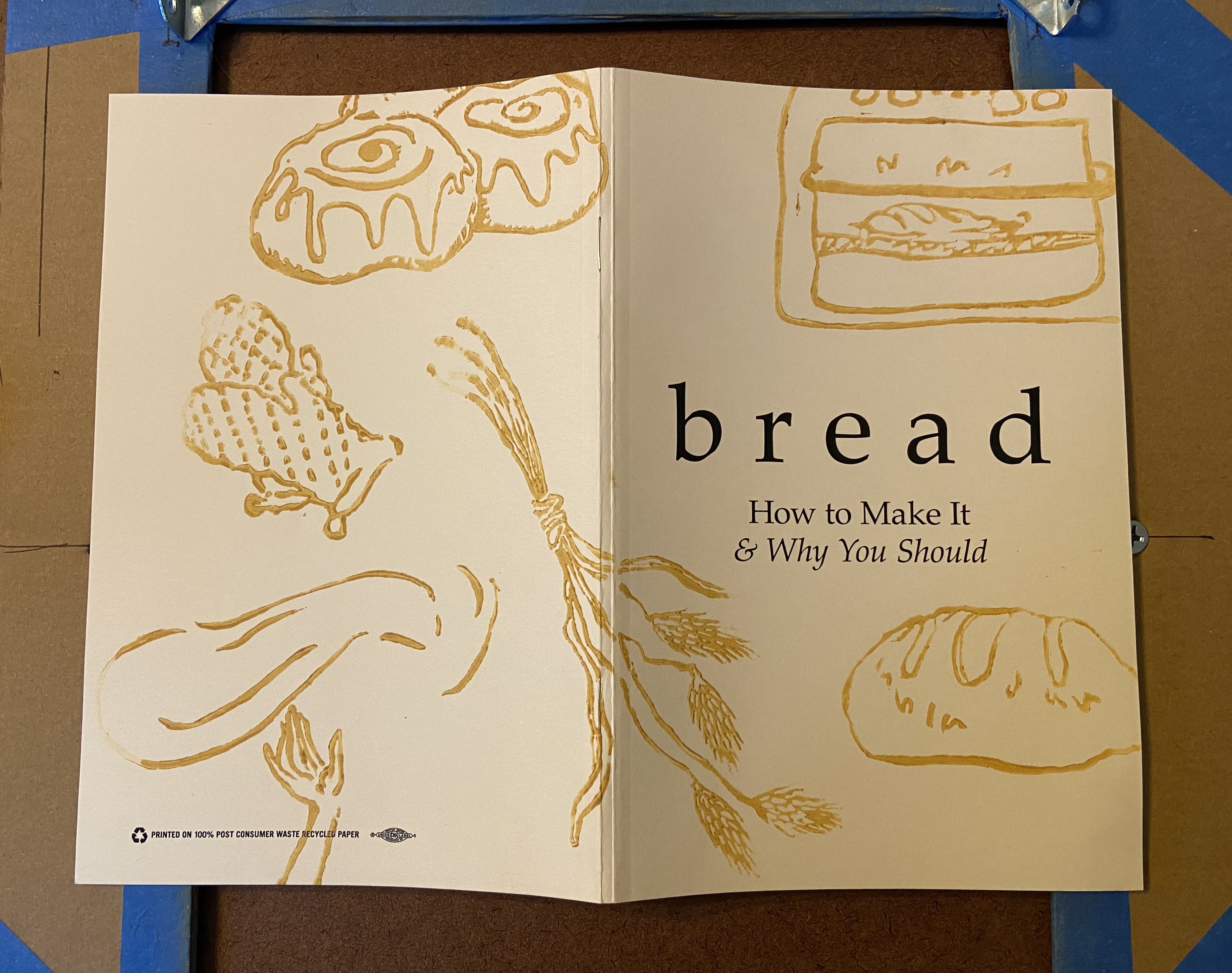
I’m sharing an excerpt from the introduction as a way of giving people a sense of what it’s like with the goal of hopefully convincing them it’s something they’d like to have. I’ve paid for all the production costs and shipping myself, with all proceeds going towards his legal bills or to him directly so he can try and rebuild his life after spending more than half of it in a cage. In spite of all the issues with his treatment by the DOC, they will provide no support for housing, employment, or even his transportation back to Mississippi. Nevertheless, they expect him to find his own housing and employment within 120 days of release or risk having his parole revoked and being sent back to prison in Wisconsin. I hope Derwin’s story and what follows encourages you to donate. You can find more information about his case and 2+ years of updates from me on his GoFundMe about his fight. With this long preface out of the way, I hope you enjoy this excerpt:
In the early days bread was basically mushed up seeds and water cooked on or near a flame. I have never done this exactly because it sounds disgusting. Nevertheless, this is essentially the same process, with some refinements, used to make bread today. Those refinements were not limited to bread. Indeed some have argued that cultivation of grains like wheat to make foods like bread is the very foundation of civilization itself.
Given the current state of things, you may be trying to figure out how to go back in time and stop this whole process. I too have felt this way, at times, but when I take a bite of great bread that I’ve made myself suddenly this whole dark carnival seems like maybe it might be worthwhile. Waking up in the knowledge that you do not need to leave the house to have a warm cinnamon roll or fresh homemade bagel is one of life’s great pleasures, and none of these breakfast classics would exist if humans had not decided to grow wheat to make bread. With this book I hope to provide a lively and fun introduction to the science and history of bread along with some simple and delicious recipes with the goal of encouraging you to participate in this oldest of human pastimes turned professions.
All proceeds from this book will go to my friend Derwin, currently incarcerated in Wisconsin. He has been denied parole 12 times since becoming eligible, and five since his “presumptive mandatory release” date ostensibly because he has failed to complete all required programming. Meanwhile other prisoners with more severe charges and longer sentences are granted parole. Notes from a recent hearing described him as “agitated and argumentative”, an account flatly refuted by the transcript finally obtained by his lawyer.
At one point in the hearing he asks if the commissioner has read the letter prepared by his attorney in support of his release, paid for through the generosity of so many who were moved by his story. The commissioner said yes, he had read it. Derwin struggles to tell the commissioner that the way he’s been treated is not fair, that his behavior in prison has shown he is not a threat to society:
Derwin: So, I’m not good with words. I’m not good with words at all. But I can tell you this here: I have a 27-year-old niece, graduating from college, going to school to get her masters. I haven’t seen her since she was like 8, 9 months old. I have a 16-year-old niece, who I never laid eyes on … The last time I seen my mother, she was 41. She’ll be 64 July the 21st.
To this impassioned plea the agent responds flatly (and I am quoting the official transcript verbatim): “yep.”
All funds raised through the sale of this book will go towards paying his attorneys fees, and any money left over will be given to Derwin directly. All the costs of production were paid by me. You can read current and past updates and make a direct donation via GoFundMe (see front matter for link).
I believe Derwin has remained in prison all these years not because he is a danger to others but because of his willingness to speak out against abuse and abysmal conditions in prison. Beyond that, it is in the best political and economic interests of some to keep him a prisoner. Companies provide food, clothing, phone, and medical services to those incarcerated. Prisoners who do not work a job in or out or prison go without or ask their loved ones for help. At one point we calculated the equivalent cost of basic items available through canteen by comparing the prison wages in Wisconsin to the minimum wage. We found that someone making the federal minimum wage of $7.25/hour would have to pay over $80 for a single bottle of Coke if they were gouged the way incarcerated workers are through the canteen system. Not coincidentally Wisconsin leads the nation in disproportionately incarcerating Black people.
In many towns with a prison, it is among the largest employers. I met him while we were both living in Oshkosh, Wisconsin, itself home to three DOC facilities. I was working as a librarian at the University of Wisconsin-Oshkosh, which like many other public institutions in the state uses furniture created and assembled by prisoners. With groups like the Incarcerated Workers Organizing Committee I have attended DOC public meetings and filed open records requests in the hopes of exposing these systemic injustices. At the same time as I was getting more involved in movements to reform or abolish prisons entirely, I began to bake bread more regularly. At the time I considered these separate or at least discrete developments. Upon further reflection they now seem related, if only on some subconscious level.
At one point after we met he was transferred to Wisconsin Secure Program Facility (WSPF), located a few hours away in Boscobel, Wisconsin. He had been transferred there after receiving only his second major conduct ticket in over twenty years in prison. It was for throwing a broom in frustration, striking another prisoner, after learning that he’d been kicked out of a program required to be granted parole. This incident is referenced repeatedly by the commissioner as a reason he cannot recommend him for release. The commissioner says the best he can do is recommend him for the same program again. Derwin is frustrated, as we now know he’s done more than 900 hours of programming, double the requirement already. Both times he had been terminated from the program not long after describing racist abuse he had suffered while in prison. At another point in his hearing he asks:
Derwin: Does it matter that I get home to my family?
Commissioner: What matters is the evaluation of the criteria. That’s what matters to me … the expectation is that you’ll successfully complete the program, demonstrate a reduction in risk so I can make the recommendation for release. All those other things are not part of the purview of my consideration.
More than a year after this hearing, he learned that the forms which are supposed to justify his programming needs and therefore further incarceration were not there. “They did not exist!” he told me, before an automatic voice reminded us that our call may be monitored and recorded.
I visited him after he was transferred to WSPF. Modeled after the Federal supermax prison, the ACLU has described WSPF as “more an experiment in sensory deprivation than a prison”. After securing my personal items in a locker and passing through the metal detector, I went through a set of double locking doors and into a courtyard. Tall fencing topped with razor wire protected perfect green rectangles of grass bordered by empty concrete walkways. I agreed with the guard escorting me to the visitor’s center when he said it was the kind of day that makes it hard to go to work inside. After another set of locking double doors I was led into the visiting room, full of knee-high tables and plastic chairs.
A guard sat at an elevated dais and a mural was obscured by various posters and flyers on the opposite wall. I got there early in the morning; there was only one other group in the room. A man in a green prison uniform held his daughter, no older than 5, in his arms while she slept. Her parents joked in whispers to keep her from waking while they shared a cinnamon roll from the vending machine.
In Victor Hugo’s sprawling epic Les Miserables, Jean Valjean is incarcerated first for the theft of bread and then for his various attempts to escape either prison or the galley of a ship he was sentenced to row. The bishop, whose forgiveness of Valjean’s theft of silver begins a journey of redemption, witnesses a public execution by hanging. Upon seeing the gallows that will execute the criminal, the bishop concludes:
“it is not neutral, and it does not permit you to remain neutral. He who sees it shivers with the most mysterious of shivers. All social problems erect their interrogation point around this chopping-knife.”
The more I learned about how US prisons operate, the more it seemed to both reflect and embody so many other problems in our government, economy, and society. I did not consider myself much of an optimist before getting involved and this has hardly improved that picture. It’s hard not to come away with a completely grim picture of all organized society.
Baking bread won’t solve these problems, but it did make me feel better. At first I assumed this was just the benefits of having a hobby, but as I learned more about the history and science of bread for this book it felt less and less coincidental. One of the last times I saw Derwin in person before moving out of Wisconsin we shared a meal together in the visiting room. He insisted on paying from his own account, wanting to “break bread” before I left town.
Bread is simultaneously ancient and contemporary. The chemical and biological processes at work in every loaf have existed for millenia, but the systems and politics that shape its production and distribution are constantly changing and have exerted a constant, though not always recognized, impact on our lives. By cultivating staple crops like wheat, humans could support larger populations. This enabled a greater diversity of labor and more concentrated human settlements, encouraging other developments in the production of textiles, pottery, and metalworking, to name a few. It shaped how humans addressed what remain fundamental political considerations today: how are basic goods necessary for survival distributed? How does this process impact other living things, both plant and animal? Who makes these decisions? How, and why, are they made?
As it happens, I have been able to develop the completely and totally perfect answer to all these questions. However, I don’t really have time to write them down right now so this short primer bread will have to do.
You can order a copy of the book by donating to Derwin’s GoFundMe.
 Orion's Bastard